
Best Business Phone Systems & VoIP Providers in 2026
 March 12, 2026
4 min read
March 12, 2026
4 min read
A service business lives and dies by client communication. Every missed call represents lost revenue. Every dropped connection signals a lack of capacity to handle serious accounts. Using a personal cell phone number to close mid-market contracts broadcasts amateur status.
In 2026, Voice over Internet Protocol is mandatory infrastructure. You need a centralized system that routes inbound leads efficiently and connects directly to your database. Modern business phone systems do more than dial out. They record conversations for quality assurance, transcribe meetings, and log client history automatically.
Relying on legacy landlines or disjointed cellular setups drains operational speed. Your sales team needs desktop applications. Your support staff requires smooth call-routing trees. Transitioning to a reliable virtual phone platform eliminates these bottlenecks. It gives you complete control over your telecom environment.
Communication Is the Backbone of Service Delivery
Whether you’re a solo consultant or running a 30-person agency, your phone system directly impacts how clients perceive your professionalism.
Clients gauge competence within the first few seconds of an interaction. An automated, poorly mapped phone tree frustrates callers immediately. Conversely, a direct, intelligent routing system builds instant trust.
When a high-value prospect calls your main line, they want rapid resolution. They expect to reach the right department without repeating their account number to three different representatives. Quality VoIP systems remove friction. They identify incoming numbers, match them against your CRM, and display the caller’s history on your team members’ screens before they even pick up.
For a digital growth agency managing sophisticated client acquisition funnels, this seamless data handoff is a fundamental operational requirement. Modern voice software bridges the gap between initial web interactions and live sales consultations. Every incoming prospect gets instantly routed to the strategist best equipped to handle their specific industry niche.
Agencies and consultancies cannot afford communication siloes. If an account manager goes on vacation, their inbound calls must automatically forward to a covering agent. Without a centralized business phone system, those calls sit neglected in a stagnant voicemail box.
Core Requirements for Modern Voice Infrastructure
Before signing a long-term contract, you must define your operational needs. Avoid platforms loaded with features you will never touch. Focus entirely on stability, integrations, and mobility.
Guaranteed Uptime and Reliability
Look for providers offering a 99.999% Service Level Agreement. This translates to less than six minutes of downtime per year. If your phone lines go dead during peak business hours, your service delivery stops outright. Demand transparency regarding network redundancy and data center locations.
Deep CRM Connectivity
Standalone phone systems create manual data entry. Your VoIP provider must sync bi-directionally with Salesforce, HubSpot, or your core operational software. Automatic call logging ensures total visibility into client interactions. Without this integration, management has zero insight into daily call volume or team performance metrics.
Strict Mobile Architecture
Remote teams require reliable mobile applications. Workers must be able to place outbound calls from their personal devices using the public business number. The desktop and mobile applications must mirror each other perfectly. Incoming calls should ring on both devices simultaneously, allowing staff to pick up immediately from any location.
Top Business Phone Systems and VoIP Providers
The telecom market is saturated. We analyzed the top contenders based on call quality, software architecture, and support structures specifically tailored for professional service firms.
RingCentral: The Enterprise Standard
RingCentral remains the heavy hitter for growing organizations. It handles high call volumes without latency issues. RingCentral is ideal for service firms spanning multiple locations or employing large, distributed teams.
- Extensive customization for interactive voice response menus.
- Complex call routing for enterprise-scale operations.
- Complete administrative control over user permissions and hardware assignments.
Dialpad: Intelligence and Automation
Dialpad builds its architecture entirely around transcription and voice intelligence. It provides real-time coaching prompts to sales reps during live calls.
- Analyzes conversational sentiment instantly.
- Logs accurate call summaries and action items into your CRM automatically.
- Operates flawlessly across desktop and mobile browsers.
Aircall: The Integration Heavyweight
Aircall ditches unnecessary video conferencing tools to focus strictly on exceptional voice software. It connects to major helpdesk and CRM platforms within three clicks.
- Deploy new public numbers or add users in seconds.
- Purpose-built for customer support teams and account managers.
- Superior integration depth with Zendesk, Intercom, and HubSpot.
Ooma Office: Simplified Voice
Not every firm requires complex AI integrations. Ooma Office targets small service businesses needing reliable, clear voice connections without enterprise software bloat. It provides essential features like a virtual receptionist, ring groups, and voicemail-to-email. Ooma excels at straightforward implementation and completely predictable billing structures.
Implementing Your New VoIP Architecture
Purchasing the software is only the first step. Execution dictates success. Transitioning phone providers presents a specific set of operational risks. You must port your existing public numbers without dropping live client calls.
- Audit your current setup: Document every existing phone number, fax line, and employee extension. Identify who owns each specific number and which ones can be safely retired. Clean data prevents delays during the porting process.
- Design your call flows: Map out precisely what happens when a client calls the main line at 2 PM versus 2 AM. Determine your exact ring groups before initiating the software switch.
- Establish routing protocols: Decide if inbound sales calls should ring sequentially down a list of reps or simultaneously across the entire department. Establish clear out-of-office forwarding rules.
- Dedicate time for training: Switchover days often result in confusion. Run test calls internally before changing your public-facing DNS records or forwarding lines. Ensure every employee has the software installed, their headset configured, and their voicemail greeting recorded.
Managing Hidden Telecom Costs
Telecom pricing is notoriously opaque. The advertised per-user rate rarely reflects your final monthly invoice. Service businesses must budget for backend expenses to accurately forecast annual software costs.
Understand the strict impact of local regulatory fees and telecom taxes. These mandatory public surcharges often add twenty percent to the base subscription price. Furthermore, check the provider’s definition of unlimited calls. Many platforms enforce fair-use limits and charge premium rates for toll-free inbound minutes or international dialing.
Evaluate hardware requirements carefully. While softphones eliminate the need for physical desk sets, your team requires professional-grade headsets to ensure consistent audio clarity. Upgrading office bandwidth may also be strictly necessary to handle concurrent VoIP traffic without jitter or dropped packets.
Need Help With Your Strategy?
Biz Gang helps service businesses build sustainable organic growth through strategic content and SEO.
Get in Touch
The Biz Gang
Further Reading

Best ITAD Services in the US (2026)
Our 2026 review of the best ITAD companies in the US, ranked by data destruction standards, chain-of-custody documentation, value recovery, and service quality.

Best B2B Telecommunications Companies in the Northeast (2026)
A 2026 review of the best B2B telecommunications companies serving Connecticut, New York, and New Jersey — six regional providers plus two national platforms for honest comparison.
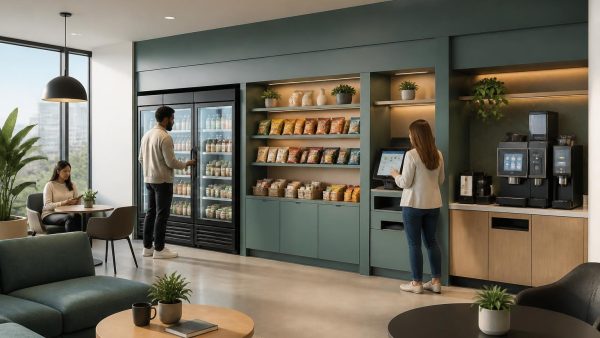
Best Vending Companies for Businesses and Offices in 2026
Compare the best commercial vending companies of 2026 — from Vending Group and Canteen to Aramark, National Vending, and independent local operators — and find the right fit for your business.