
Stop Treating Office Coffee Like an Afterthought: Build a Managed Coffee Station People Actually Use
 March 31, 2026
5 min read
March 31, 2026
5 min read
Office coffee is almost universally terrible. We accept this as a standard corporate reality. Sludge at the bottom of a glass pot, generic powdered creamer, and a crusty drip machine tucked into a dark corner sets an immediate, low baseline for how you treat your staff. Facilities management is an extension of company operations. If your breakroom looks like a neglected afterthought, your employees notice.
Managing a commercial environment means actively curating the workspace. Providing a decent cup of coffee is basic professional hospitality. Yet, growing companies still struggle to execute this simple mandate. They treat supplies as ad-hoc Amazon purchases rather than a managed, repeatable service. This results in chaotic procurement, broken machines, and a frustrating daily experience for the team.
Quick Answer: What a Real Office Coffee Station Needs
A functional office coffee station includes: a reliable machine, coffee people actually want to drink, cups and lids, creamers and sweeteners, stirrers, tea and decaf options, and a system for restocking and maintenance.
That last point is where most businesses fail. Buying the hardware is easy. Maintaining the system is the actual work. You need a baseline inventory threshold so nobody has to write passive-aggressive sticky notes about running out of sugar packets. It requires defined operational mechanics.
Why Coffee Matters More Now
The office has to compete with home now. Gensler’s 2025 Global Workplace Survey found employees in great workplaces are nearly three times more likely to stay. CBRE’s 2025 survey found food and beverage options ranked as the third most favored must-have office amenity at 39%.
Return-to-office mandates are causing friction. Employees spent the last three years curating their home environments. They have good, reliable coffee setups in their own kitchens. Forcing them back into a commute, only to offer them inferior tools and stagnant amenities, breeds resentment. The physical workspace requires a tangible upgrade to justify the mandate.
Your breakroom acts as a primary tool for retention. When you provide high-tier amenities, you signal that you respect your team’s physical comfort. Premium coffee service transforms a sterile corporate kitchen into a functional hub. It costs a fraction of your payroll, but the psychological impact on office morale is disproportionately high.
The Real Problem With DIY Coffee Stations
Most companies attempt to handle breakroom operations internally. This is a quiet drain on operational resources. Look closely at how the DIY approach actually functions on a daily basis.
- Someone has to notice supplies are low
- Someone has to order, track delivery, unpack, and store everything
- Someone has to clean the machine, descale it, and troubleshoot issues
- Someone gets the complaints when the coffee is bad
- Someone has to rotate options, track shelf life, and keep the area presentable
Take a hard look at who is doing this work. It usually falls onto an office manager, an administrative assistant, or simply the most responsible person on the floor. You are paying professional salaries for someone to play barista and inventory clerk. That is terrible resource allocation. Every hour an employee spends scrubbing a carafe or cross-referencing coffee pod prices on a corporate credit card is an hour stolen from their core responsibilities.
Strategic outsourcing is the most effective way to eliminate these distractions. Just as a proactive digital marketing agency services small business growth by capturing new external leads, a reliable facility provider sustains internal operations. This kind of intentional delegation ensures your team’s valuable time is never wasted on secondary chores.
The DIY approach also guarantees inconsistency. When the designated supply manager goes on vacation, the system collapses. The milk goes sour. The machine calcifies. The decaf drinkers are left with nothing. A managed service removes this entire administrative burden. You outsource the friction, ensuring the station is restocked automatically and your staff stays focused on actual business operations.
Productivity: Coffee Isn’t Magic, But the Mechanics Matter
EFSA-backed guidance confirms that 75 mg of caffeine can increase attention and alertness. Nespresso survey data found 81% of employees say coffee breaks help build stronger relationships.
The physiological benefits of caffeine are well documented. Alert employees make fewer errors and sustain deep work longer. But the operational mechanics of how they acquire that caffeine sit at the center of workspace efficiency. If your coffee is undrinkable, your team will leave the building. A trip to the local coffee shop takes twenty to thirty minutes. Multiply that by thirty employees, twice a day, and you are bleeding productive hours.
Additionally, the breakroom acts as a necessary collision space. Modern offices suffer from departmental silos. The design team rarely speaks to accounting. The coffee machine forces physical intersection. These spontaneous micro-interactions often solve cross-departmental bottlenecks faster than a scheduled block on a calendar.
Choosing the Right Machine
Hardware dictates the experience. You cannot drop a domestic appliance into a commercial environment and expect it to survive. You need commercial-grade equipment built for heavy cyclic use.
- Pod-based systems for small-to-mid offices
- Bean-to-cup machines for better freshness
- Commercial drip brewers for high volume
Pod systems offer incredible variety. They work perfectly when you have diverse preferences but lower overall foot traffic. However, the per-cup cost scales poorly for large organizations, and the environmental footprint requires a dedicated recycling procedure to manage waste effectively.
Bean-to-cup machines are the current gold standard for the modern office. They provide a premium, cafe-level experience with minimal user input. Employees press a button, internal grinders process fresh beans, and the machine handles the extraction. They require direct water lines and precise cleaning schedules, which makes them ideal for a managed service contract.
Commercial drip brewers exist for sheer volume. If you need to caffeinate a call center or a massive warehouse shift over a twenty-minute period, nothing beats thermal carafes holding gallons of hot, ready-to-pour coffee. Match the hardware to your operational velocity and peak usage times.
How Managed Coffee Fits Into the Bigger Picture
Fragmented operations create chaos in the back office. If you have one vendor for water filtration, another for coffee, a third for snacks, and a fourth for sodas, your accounts payable department is drowning in low-value invoices. Your facility manager spends entirely too much time juggling multiple contact sheets for simple equipment repairs.
Look at breakroom solutions as a single managed program. Understand how vending machines for the office work.
Consolidation is the only viable way to scale facilities management. A unified approach gives you purchasing leverage, simplified billing, and a single point of accountability when things break. You want your entire breakroom ecosystem operating seamlessly in the background without constant internal intervention.
Bottom Line
Stop treating office amenities as a reactive chore. Your team’s environment shapes their output. When you invest in a professional, managed coffee program, you eliminate administrative waste and set a high standard for your workspace.
Work with a vending placement company that can support the full footprint.
Need Help With Your Strategy?
Biz Gang helps service businesses build sustainable organic growth through strategic content and SEO.
Get in Touch
The Biz Gang
Further Reading
Best ITAD Services in the US (2026)
Our 2026 review of the best ITAD companies in the US, ranked by data destruction standards, chain-of-custody documentation, value recovery, and service quality.
Best B2B Telecommunications Companies in the Northeast (2026)
A 2026 review of the best B2B telecommunications companies serving Connecticut, New York, and New Jersey — six regional providers plus two national platforms for honest comparison.
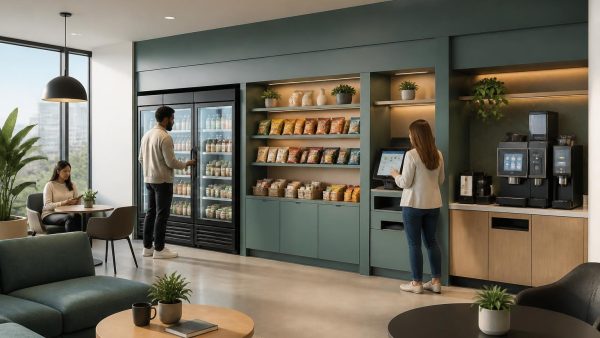
Best Vending Companies for Businesses and Offices in 2026
Compare the best commercial vending companies of 2026 — from Vending Group and Canteen to Aramark, National Vending, and independent local operators — and find the right fit for your business.